
Posted on April 27, 2026
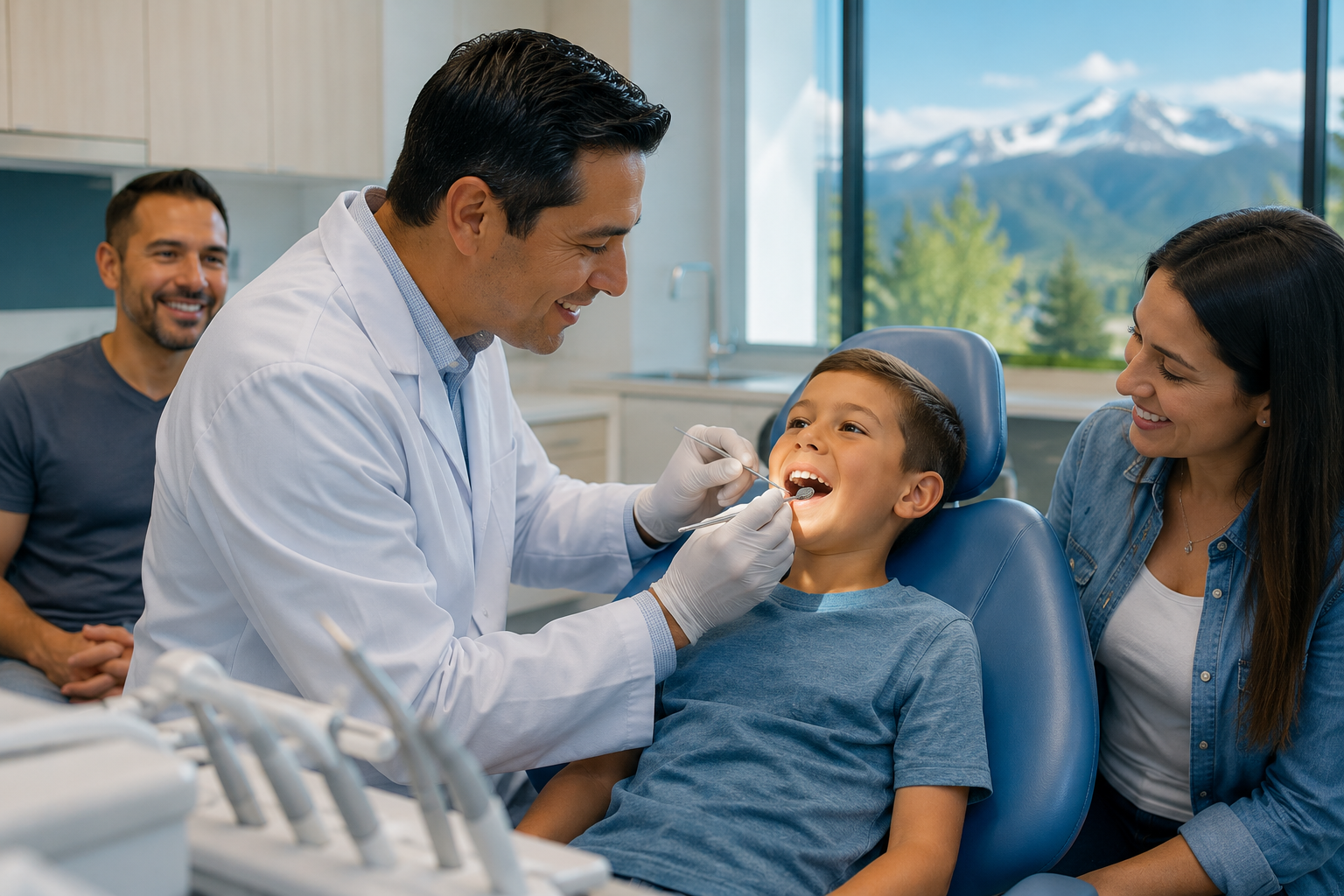
The American Association of Orthodontists recommends a first orthodontic evaluation by about age 7, though that visit is about screening, not necessarily starting treatment right away. Most Denver kids begin active treatment between ages 9 and 14, once enough adult teeth have erupted, while adults can start orthodontic treatment at any age. The right time depends on your child’s specific bite, not a birthday.
The American Association of Orthodontists sets one clear benchmark, but the rest of the timeline depends on how your child’s mouth and jaw are developing. This guide lays out what that benchmark means and what typically comes after it.
At Smilebliss Orthodontics, we get asked constantly whether there is one “right” age to start orthodontic treatment. The honest answer is that age is only part of the equation.
A quick evaluation is the only way to know where your child actually stands against that timeline. Contact us today to schedule a free evaluation and get a clear answer.
The American Association of Orthodontists recommends every child have a first orthodontic evaluation by about age 7. That recommendation is not about starting treatment early; it is about catching developing issues while a child’s jaw still has growth left to guide.
By age 7, most kids have enough of a mix of baby and adult teeth for an orthodontist to spot patterns that predict future crowding, bite problems, or jaw discrepancies. Not every child needs treatment at this visit, and most do not.
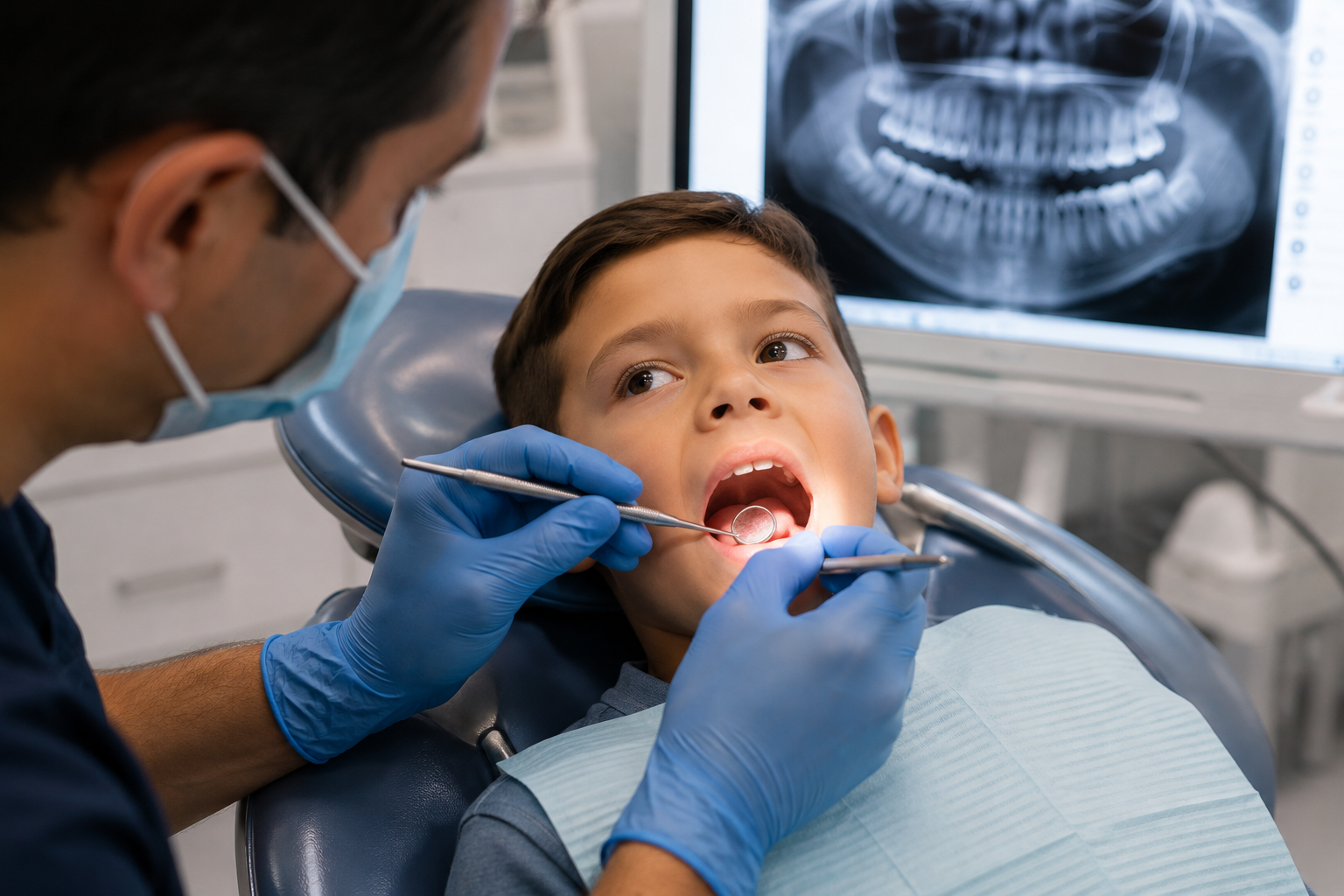
For Denver families, this first check is straightforward: a visual exam, a bite assessment, and occasionally a panoramic X-ray to see how the permanent teeth are positioned beneath the gumline. Most children evaluated at age 7 are simply placed on a monitoring schedule, with follow-up visits every six to twelve months to track how the bite and jaw continue to develop.
If a problem does surface, catching it during this window often means a shorter, simpler treatment plan later, since the jaw still has active growth to work with rather than a fully set adult structure.
 Early crowding is easier to guide with simple, limited interventions than to correct later once all adult teeth have fully erupted. An age 7 check catches this pattern while options are still simple.
Limited crowding caught early can sometimes be managed with a simple space maintainer or a short phase of guided expansion, rather than a full set of braces. Waiting until all the permanent teeth have erupted often leaves less room to work with, which can turn a straightforward fix into a more involved case requiring extractions or a longer treatment timeline.
Some bite issues stem from how the upper and lower jaw are growing relative to each other, not from tooth position alone. These are far easier to influence while a child is still growing.
A jaw that is growing too far forward, too far back, or unevenly from side to side is far easier to redirect at this stage than after growth has finished. Early guidance in these cases sometimes uses simple appliances to steer the jaw into better alignment, which can reduce or eliminate the need for more complex correction later on.
An early check can reveal whether incoming permanent teeth have enough room to erupt properly. Guiding that space early sometimes prevents the need for extractions or more complex treatment later.
Space management at this stage can be as simple as monitoring or as involved as a small appliance that holds room open for a tooth that has not yet erupted. Either way, the goal is the same: give every permanent tooth a real chance to come in where it belongs, rather than crowding into whatever space is left.
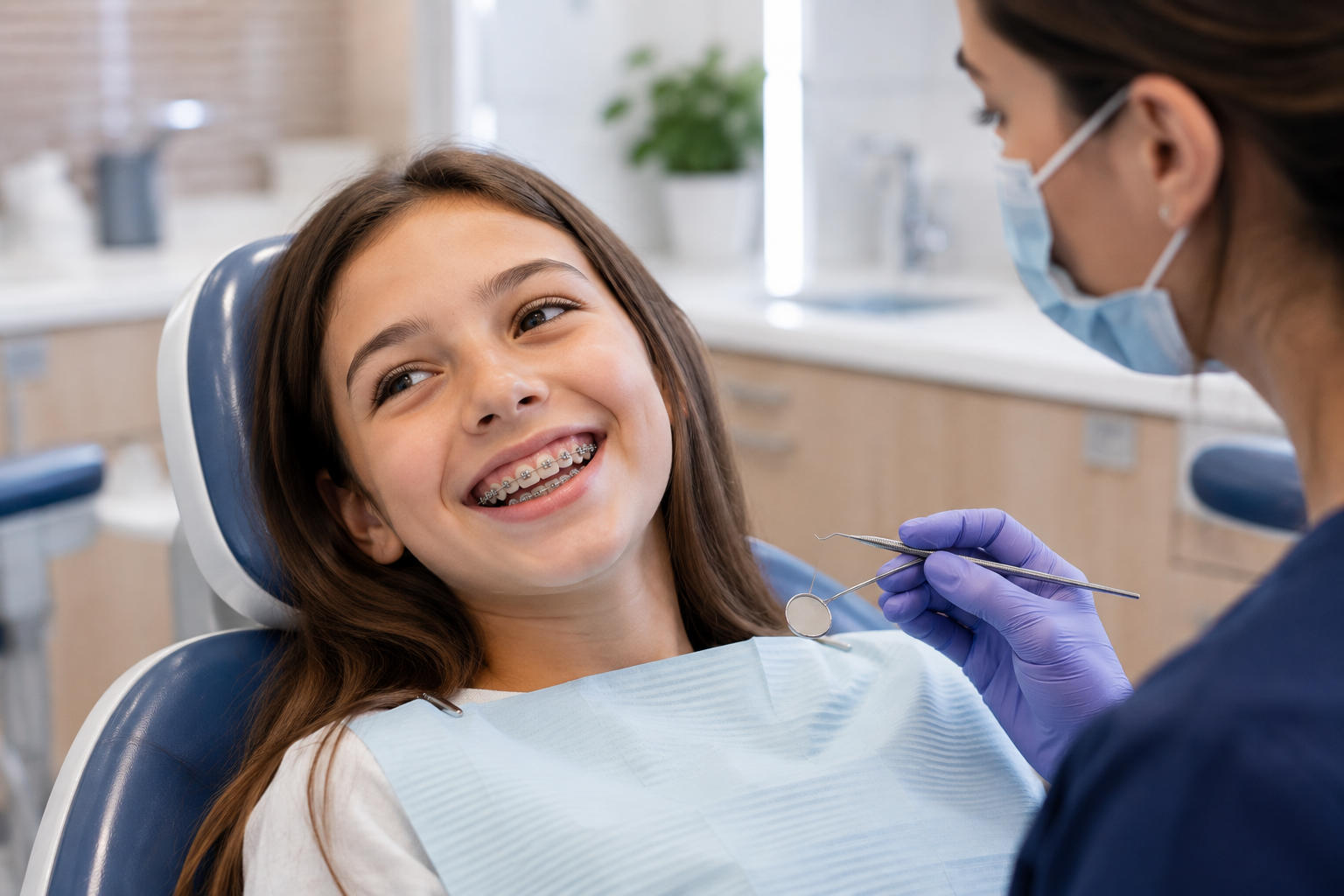 Most Denver kids do not start active treatment at age 7. Active treatment typically begins between ages 9 and 14, once enough permanent teeth have erupted to move the full set predictably as a group.
The exact starting point depends on your child’s individual dental development, not a fixed birthday. We track that progress from the first evaluation forward so treatment starts at the point that gives the best result.
Between ages 9 and 14, most kids have replaced enough baby teeth that braces or clear aligners can move the entire arch as a coordinated unit, rather than working around teeth that have not erupted yet. This is also the window where growth can still be used to an orthodontist in Denver‘s advantage, particularly for bite discrepancies that are harder to influence once jaw growth slows in the later teenage years.
Treatment length in this age range commonly falls between 18 and 24 months, though every case is different.
There is no upper age limit on orthodontic treatment. Traditional metal braces work reliably on a fully developed adult jaw, just as they do on a teen’s, though adult cases sometimes move a little more slowly.
The same principle applies whether your child is approaching their teenage years or you are considering treatment as an adult yourself: healthy teeth and gums matter more than the number on your birth certificate.
Adult orthodontic treatment has grown significantly more common in recent years, driven partly by clear aligner options that fit more easily into a working adult’s routine than traditional visible braces. The biology of tooth movement does not change with age, though adults with a history of gum disease may need a periodontist involved alongside their orthodontist to confirm the supporting bone can handle the movement safely.
Families researching braces in Denver for a teenager or for themselves are asking the same underlying question: is my bite ready, not how old am I.
The best age to start is the age your specific bite is ready for it, not a number pulled from a general guideline. An in-person evaluation is the only way to know that for certain. At Smilebliss in Denver, Dr. Alejandro Arango has guided families through exactly this decision.
Call us today at (720) 706-8482 to schedule a free evaluation at 1050 South Wadsworth Blvd., Suite H, Lakewood, CO 80226.
The American Association of Orthodontists recommends a first evaluation by about age 7. This visit screens for developing issues rather than starting treatment immediately, and most children at this age need no intervention yet. The goal is simply to establish a baseline so growth can be tracked from here forward.
No, most children evaluated at age 7 do not need braces immediately. The visit simply establishes a baseline so any developing issue can be tracked and addressed at the right point in growth. Most kids seen at this age are placed on a monitoring schedule and reevaluated every six to twelve months.
A first evaluation typically includes a visual exam, a review of how teeth and jaws are developing, and sometimes digital x-rays. The orthodontist then explains whether monitoring or early treatment makes sense, and answers any specific questions about your child’s bite.
Yes, missing the age 7 evaluation does not close any doors. Most orthodontic treatment for teens still starts once enough permanent teeth have erupted, regardless of when the first check happened. An evaluation at any age still gives a clear, accurate starting point.
No, there is no upper age limit. Traditional metal braces work reliably on adults just as they do on teens, since the underlying tooth-movement process works the same way at any age. Adult cases sometimes move a little more slowly, but the outcome is not limited by age.
Signs include noticeable crowding, teeth that do not meet properly when biting down, thumb-sucking habits past early childhood, or jaws that appear mismatched in size. An evaluation confirms whether treatment is actually needed, so parents are not left guessing based on appearance alone.
Timelines vary by case more than by age group, though traditional treatment commonly runs 18 to 24 months for teens. Starting at the right developmental point, not the youngest possible age, produces the most efficient timeline and reduces the odds of needing a second phase of treatment.
No, waiting for all baby teeth to fall out can mean missing the ideal window for early guidance. The AAO’s age 7 recommendation exists specifically because useful information is visible well before that point, while a mix of baby and adult teeth is still present.
