
Posted on May 19, 2026

Clear aligners let busy Denver professionals straighten their teeth without visible brackets or the frequent adjustment visits traditional braces require, with most cases needing a new tray every one to two weeks. Treatment starts at $3,998 and includes checkups spaced further apart than metal braces. The tradeoff is discipline: aligners only work if worn 20 to 22 hours a day.
There’s no bracket to work around during client meetings and no wire to explain in a video call. The bigger tradeoff is not visibility; it’s discipline, and this guide lays out exactly what that means day to day.
At Smilebliss Orthodontics, most of the professionals who come through our doors ask the same question first: how does this fit into a schedule that’s already full? Clear aligners were built with exactly that concern in mind.
If your schedule is the main thing holding you back from starting treatment, a quick conversation usually changes that math. Contact us today to schedule a free consultation and see if aligners fit your case.
Clear aligners are nearly invisible, removable, and require fewer in-office visits than traditional metal braces. For professionals juggling meetings, travel, and client-facing work, that combination removes most of the friction that keeps people from starting treatment.
Instead of adjusting wires every few weeks, most aligner patients switch to a new tray at home every one to two weeks and only check in with the orthodontist every six to eight weeks.
For a professional who travels for client work or sits in back-to-back meetings, the calendar rarely has room for a mid-morning orthodontist visit every few weeks. Clear aligners are designed around that reality: most of the actual movement happens between appointments, at home, tray by tray, rather than during a chairside adjustment.
That shifts the time commitment away from the office and onto a five-minute routine before bed. It also means a single missed or rescheduled visit does not set treatment back the way a skipped wire adjustment can, since the trays keep working on their own schedule.
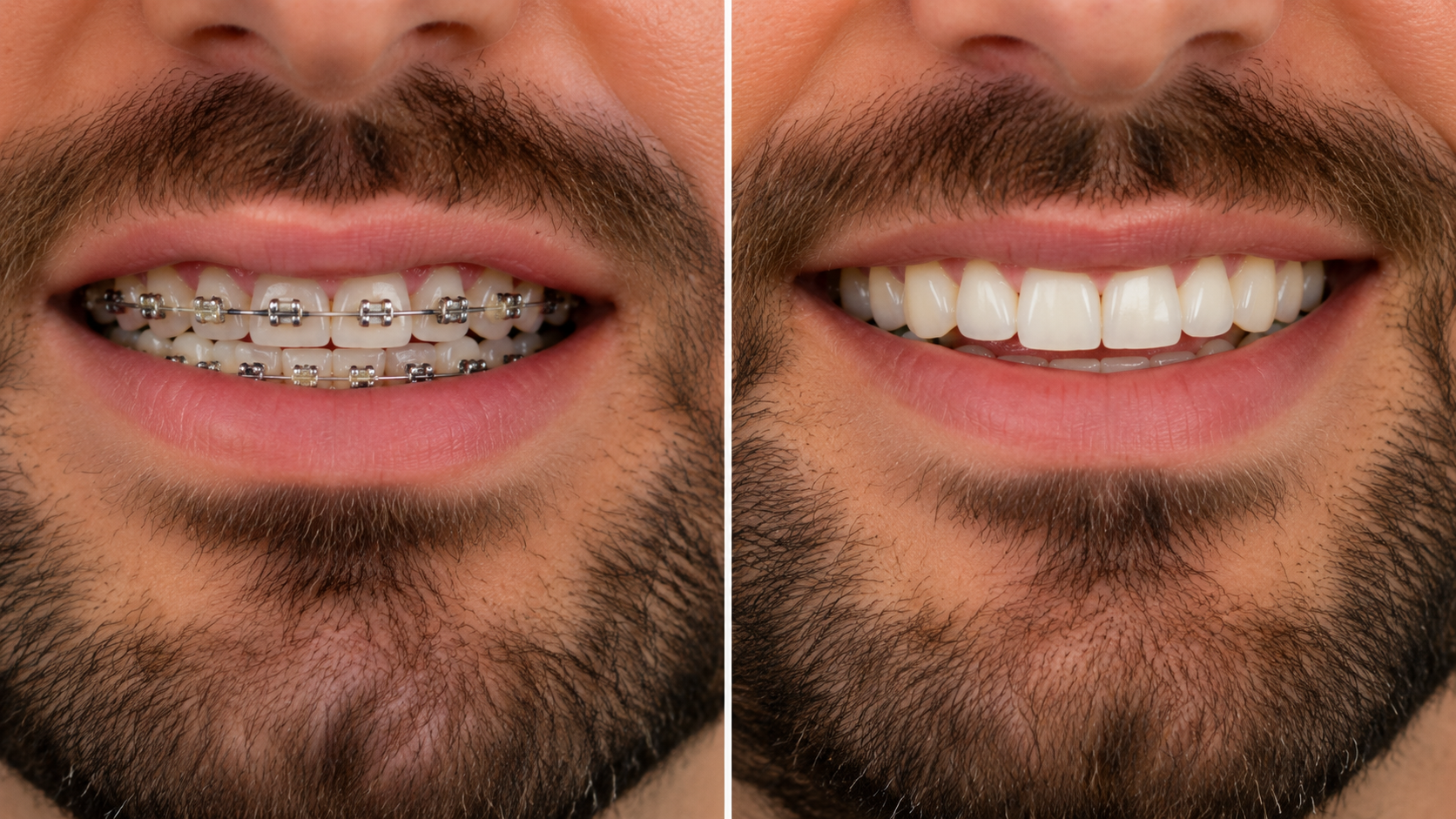 Aligners are clear, custom-fitted trays with nothing bonded to your teeth. There’s no bracket to catch on a phone call or wire to worry about before a presentation.
That matters most in moments that are hard to plan around, like a client dinner that runs long or a same-day flight change. A bracket that catches on a straw or a wire that pokes the cheek is a distraction a professional does not have time for mid-presentation. Aligners remove that specific failure point, since there’s nothing rigid bonded to the teeth that can shift, break, or need an emergency repair visit.
Traditional braces need adjustment visits every few weeks. Aligner patients typically check in every six to eight weeks, since most of the progress happens tray by tray at home.
Fewer visits also means fewer blocks of missed work time. A traditional adjustment appointment often means leaving the office mid-afternoon and losing the rest of that block to travel and waiting room time. Spacing checkups six to eight weeks apart instead of every three to four weeks adds up to noticeably fewer missed workdays over a full treatment plan.
Aligners come out for eating, drinking anything besides water, and brushing, which means no food restrictions and no cleaning around brackets. Just remember to put them back in right after.
That flexibility matters for anyone whose job involves client lunches, conference travel, or long presentation days. Aligners come out cleanly right before a meal and go back in right after brushing, without the food-avoidance list that comes with brackets. The only real requirement is discipline about putting them back in immediately, since time spent out of the mouth doesn’t count toward the daily wear target.
Aligners move teeth exactly like braces do, but only while they’re actually in your mouth. Most treatment plans call for 20 to 22 hours of wear a day, which leaves a narrow window for meals and brushing.
Professionals who travel frequently or eat out for client meetings sometimes underestimate how much discipline that requires. Traditional metal braces remove that variable entirely, since there’s nothing to remember to put back in.
This is where honesty upfront saves frustration later. A tray left in a jacket pocket during a long client dinner, or forgotten after a working lunch, adds up over a treatment plan that already spans many months. Professionals who travel across time zones sometimes find it easier to set a phone reminder tied to their normal meal schedule, rather than relying on memory alone during a hectic work week.
Aligners work well for mild to moderate crowding and spacing, and less well for complex bite corrections that need more precise, continuous force. A quick exam tells you which category your case falls into.
Cost for clear aligner treatment starts at $3,998, with the same zero-interest financing, HSA, FSA, and insurance options available for traditional braces. The right choice depends on your bite, not just your calendar.
Case complexity, not schedule, is what an exam actually measures. Mild rotations and modest spacing respond well to the incremental force aligner trays apply, while larger bite discrepancies or significant crowding sometimes need the more constant pressure traditional brackets provide. Bringing a full history of any prior orthodontic work to your exam also helps things move faster, since it gives Dr. Arango a clearer starting point for what your teeth have already done.
The busiest schedule in Denver can still make room for straighter teeth, especially with fewer office visits and no brackets to plan around. A quick exam tells you exactly what your case needs.
At Smilebliss in Denver, Dr. Alejandro Arango helps working professionals choose between aligners and traditional braces based on what actually fits their bite. Call us today at (720) 706-8482 to schedule a free consultation at 1050 South Wadsworth Blvd., Suite H, Lakewood, CO 80226.
Clear aligner treatment starts at $3,998, with zero-interest in-house financing, HSA, FSA, and most dental insurance accepted. Your exact cost depends on how complex your case is at the time of your exam, since more involved crowding or bite correction can affect the total number of trays needed.
Most treatment plans call for 20 to 22 hours of wear per day, removing them only for eating, drinking anything besides water, and brushing. Less wear time extends your overall treatment timeline, and consistently skipping hours can add weeks or months to your original plan.
For mild to moderate crowding and spacing, aligners are typically just as effective. Complex bite corrections often respond better to traditional metal braces, which apply more continuous, precise force, and a quick exam is the fastest way to know which category your case falls into.
Most patients switch to a new tray every one to two weeks as each one guides teeth slightly further into position. Your orthodontist sets the exact schedule based on your treatment plan, and rushing ahead of that schedule can leave teeth without enough time to settle.
Yes, aligners come out for meals, so there are no food restrictions like there are with traditional braces. Just remove them before eating and drinking anything besides water, and then brush before putting them back in to avoid trapping food particles against the trays.
Most aligner patients check in every six to eight weeks, less frequently than the adjustment schedule for traditional braces. Most of the tooth movement happens tray by tray in between visits, which is why missing a checkup rarely derails a treatment plan the way a skipped brace adjustment can.
Aligners work well for mild to moderate crowding and spacing. A quick exam determines whether your specific case is a good fit or whether traditional braces would work better for your bite, particularly if the correction involves significant rotation or a more complex bite issue.
Not necessarily, though wearing them fewer than the recommended 20 to 22 hours a day can extend treatment. Consistent wear typically keeps aligner timelines comparable to traditional braces for similar cases, while inconsistent wear is the single biggest reason aligner treatment runs longer than planned.
